


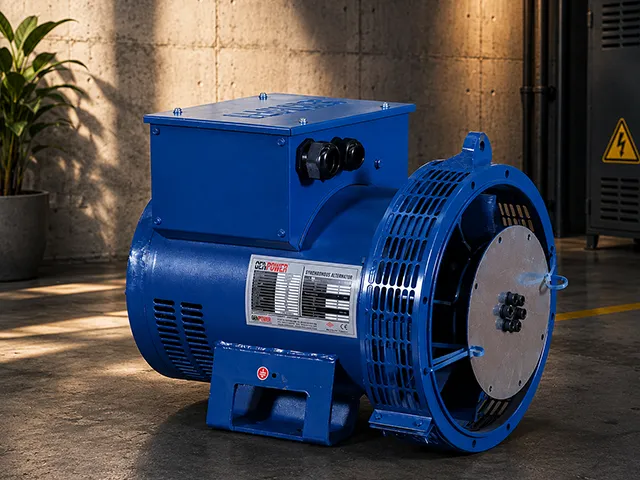
How much is an alternator? The cost depends on the required power output, phase configuration, voltage, frequency and intended application. Alternators used in generator sets may differ considerably in size and technical structure.
How much is an alternator? Brand, winding material, insulation class, enclosure rating, excitation system and voltage regulation also influence the quotation. Installation requirements, control system compatibility and operating conditions should be considered alongside the initial purchase cost.
Alternator replacement cost depends on the generator set’s capacity and the specifications of the existing unit. The replacement alternator must be compatible with the engine speed, mechanical connection, output voltage, frequency and control system. Selecting a unit based only on its power rating can lead to installation difficulties or unstable electrical output.
The main factors affecting replacement cost include:
The operating environment also affects the selection. Alternators used in dusty, humid, coastal or high-temperature locations may require additional protection. A replacement project may also involve alignment, coupling, cable, panel and control adjustments.
A complete quotation should state whether removal, installation, alignment and load testing are included. Comparing technically equivalent products gives a more accurate view of the replacement cost.
The final amount varies according to the generator set’s design, installation location and required electrical output. Replacing a compact alternator in an accessible generator may require limited work, while larger industrial systems may need lifting equipment, specialist labour and detailed commissioning.
Before replacement, technicians should confirm that the existing alternator is the source of the problem. Irregular voltage, overheating or insufficient output may also result from the AVR, control panel, wiring, circuit breaker, engine-speed regulation or connected load. Testing these components can prevent unnecessary replacement.
New, reconditioned and application-specific alternators may carry different warranty and service conditions. The quotation should therefore identify the unit’s rated output, winding material, phase configuration, protection class and included services. Installation and testing costs should also be listed separately.
Alternator repair cost is determined by the failed component, alternator capacity and extent of internal damage. Some faults may involve the automatic voltage regulator, bearings, terminals or wiring. More extensive problems can affect the rotor, stator, excitation system or windings.
An alternator should be inspected and tested before a repair method is selected. Insulation resistance tests, winding measurements, bearing checks and output tests can help identify the source of the fault. Repair may be practical when the main structure remains usable and suitable components are available.
|
Service option |
Suitable situation |
|
AVR replacement |
Output voltage is unstable or cannot be regulated. |
|
Bearing replacement |
Noise, vibration or excessive movement is detected. |
|
Connection repair |
Terminals, cables or internal connections are damaged. |
|
Winding repair |
Stator or rotor windings have localised damage. |
|
Rewinding |
Insulation failure or extensive winding damage is present. |
|
Full replacement |
Repair is technically unsuitable or uneconomical. |
Alternator repair may also require cleaning, drying, balancing or insulation treatment, depending on operating conditions. The quotation should state which components will be repaired, which parts will be replaced and what tests will be performed afterward. Warranty coverage and expected downtime should also be considered when comparing repair with complete replacement.




 Linkedin
 Facebook
 Instagram
 Twitter